Professional pipe insulation is essential for building services, energy conservation, and preserving structural integrity.
What is pipe insulation?
Pipe insulation is essentially a protective covering placed on various pipelines, such as heating, hot and cold water, air conditioning, or drainage pipes. Its main purpose is to curb heat loss, prevent annoying condensation and freezing, and effectively dampen noise. Pipe shells are most commonly made from closed-cell foam materials, such as PUR and PIR foam, foamglass, elastomeric foam, or rockwool.
The manufacturing technology of pipe insulation products depends on the raw material. Most often, manufacturers form the precise pipe shell geometry by extrusion, moulding, or precision cutting from foam blocks. In some cases, the outer surface also includes an aluminium foil lamination layer for better protection.
Extrusion
During extrusion, the thermoplastic polymer raw material is melted and then continuously pressed through a special forming die. It is primarily used for manufacturing flexible polyethene (PE) pipe shells.
Advantages:
- Outstanding productivity: It can produce large quantities of standard pipe shells continuously at extremely high speed.
- Uniform cross-section: Ensures a completely homogeneous product of consistent quality.
Disadvantages:
- High initial costs: Manufacturing specially shaped extrusion dies and heads is expensive and time-consuming.
- Inflexibility: Once the die is made, changing the insulation profile shape is difficult. Extrusion alone cannot always achieve custom details and special shapes.
Mold Foaming
Here, a two-component liquid raw material is injected at high pressure into a closed mould. As a result of the chemical reaction, the foam expands and takes on the internal shape of the closed tool. This process is primarily used to manufacture rigid PUR/PIR pipe shells and elbows.
Advantages:
- It produces products with good mechanical properties.
- The mould can also include custom joints or connecting surfaces.
Disadvantages:
- Very high tooling costs.
- Low manufacturing flexibility.
- Long cycle times, slower production.
CNC Machining Cutting
The most flexible solution for custom and serial production from foam blocks.
For cutting XPS and EPS thermoplastic foams, hot wire cutting equipment can be used. For foam materials that cannot be processed with heat (e.g., soft sponge, PIR foam, glass wool, rock wool), fast wire technology is employed for shape cutting. In fast wire foam cutters, an endless, high-speed rotating, special steel-based twisted wire cuts the material through mechanical friction. It's an abrasive technology.
Advantages:
- Ideal even for small series: Perfectly economical for custom production, prototypes, and small- and medium-series runs.
- Outstanding flexibility: You can easily create any custom geometry, size, or complex profile.
- Quick setup: You can modify designs and dimensions in the software in moments.
- No tooling costs: For a new product or custom size, you don't need to manufacture expensive moulding or pressing tools.
Disadvantages:
- Lower production speed.
- Accounts for some material loss and waste due to the cutting process.
Manufacturing Pipe Insulation with the Coner Fastwire CNC Foam Cutter
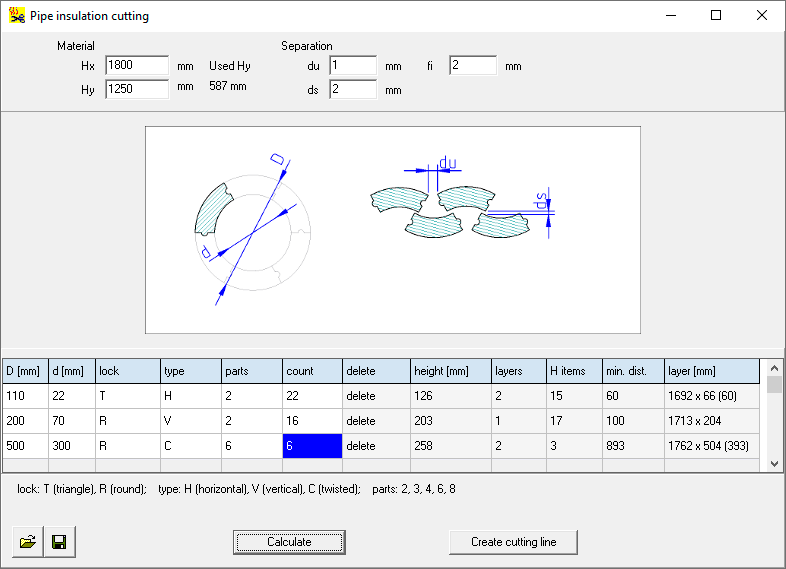
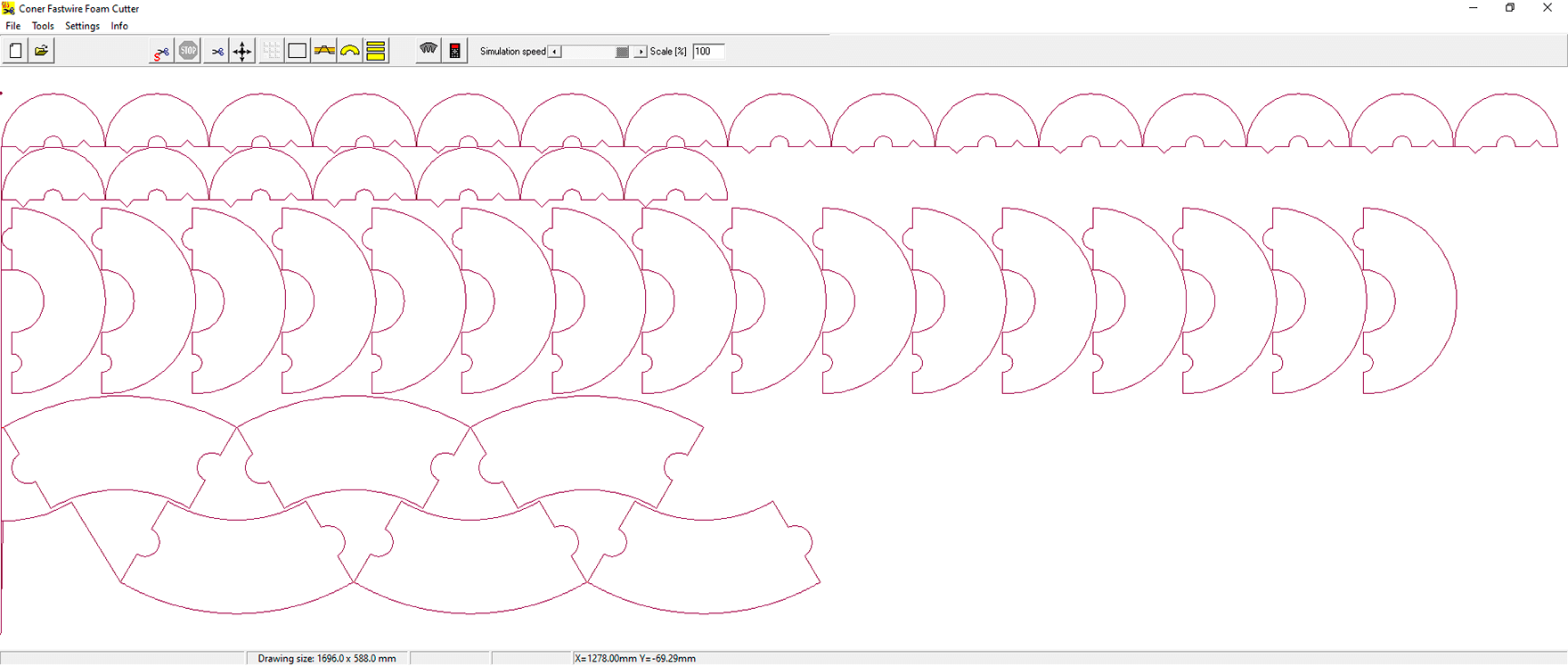
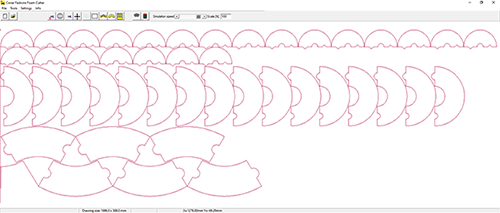
The SoftCut FW software provided with the Coner Fastwire foam cutter allows operators to create drawings and cut pipe insulation according to the set parameters. It also includes numerous automated functions that help optimise material usage.
After you enter the data required for pipe shell production, the software automatically plans the cutting path and generates the drawing while accounting for the cutting wire thickness.
You can join the individual pipe shell segments in a semi-circular or triangular shape.
The curved insulation elements can be arranged horizontally, vertically, or rotated relative to each other.
Insulation for Larger Tanks
For hard foam insulation of larger-diameter pipes or tanks, the pipe shell may not be producible in two parts due to its size.
With a special (paid) option, the insulation ring can be divided not only into two, but into up to 3, 4, 6, or 8 segments.

 Coner Fastwire foam cutter
The design and surface treatment of abrasive cutting wires for fast wire machines fundamentally determine the cutting quality, wire lifespan, and the range of processable materials.
Check out the range of cutting wires!